P2008JC · Emergency Procedures · 03 of 10
Engine Failure and Restart
- 01 · LOCKEDEmergency Fundamentals
- 02 · LOCKEDElectrical, Avionics and Pitot Heat Failures
03 · READING NOW
Engine Failure and Restart
Where the engine quits decides everything about what you do next. On the ground you are stopping an aeroplane; just after rotation you are landing one, almost straight ahead, with seconds to choose. Both opening blocks are bold faces.
At a glance
- Minimum speed, engine failure after take-off61 KIAS
- Landing direction after take-off failurestraight ahead, changes of direction not exceeding 45° left or 45° right
Engine failure during the take-off run
Steps 1–3 are memory items — known by heart, flown in the correct and complete sequence. Steps 4–7 follow once the aircraft is safely stopped.
Throttle — IDLE (keep fully out)
Rudder — keep heading control
Brakes — apply as needed
Ignition key — OFF
Fuel selector valve — OFF
Electric fuel pump — OFF
Alternator & Master switches — OFF
Engine failure immediately after take-off
Steps 1–8 are memory items — known by heart, flown in the correct and complete sequence. Steps 4–8 are flown at, or right before, touch down.
Speed — keep minimum 61 KIAS
Find a suitable place to land safely
Flaps — as needed
Throttle — IDLE (fully out and hold)
Ignition key — OFF
Fuel selector valve — OFF
Electric fuel pump — OFF
Alternator & Master switches — OFF
WARNING — Plan the immediate landing straight ahead. Only small changes of direction are acceptable, and they may not exceed 45° either side.
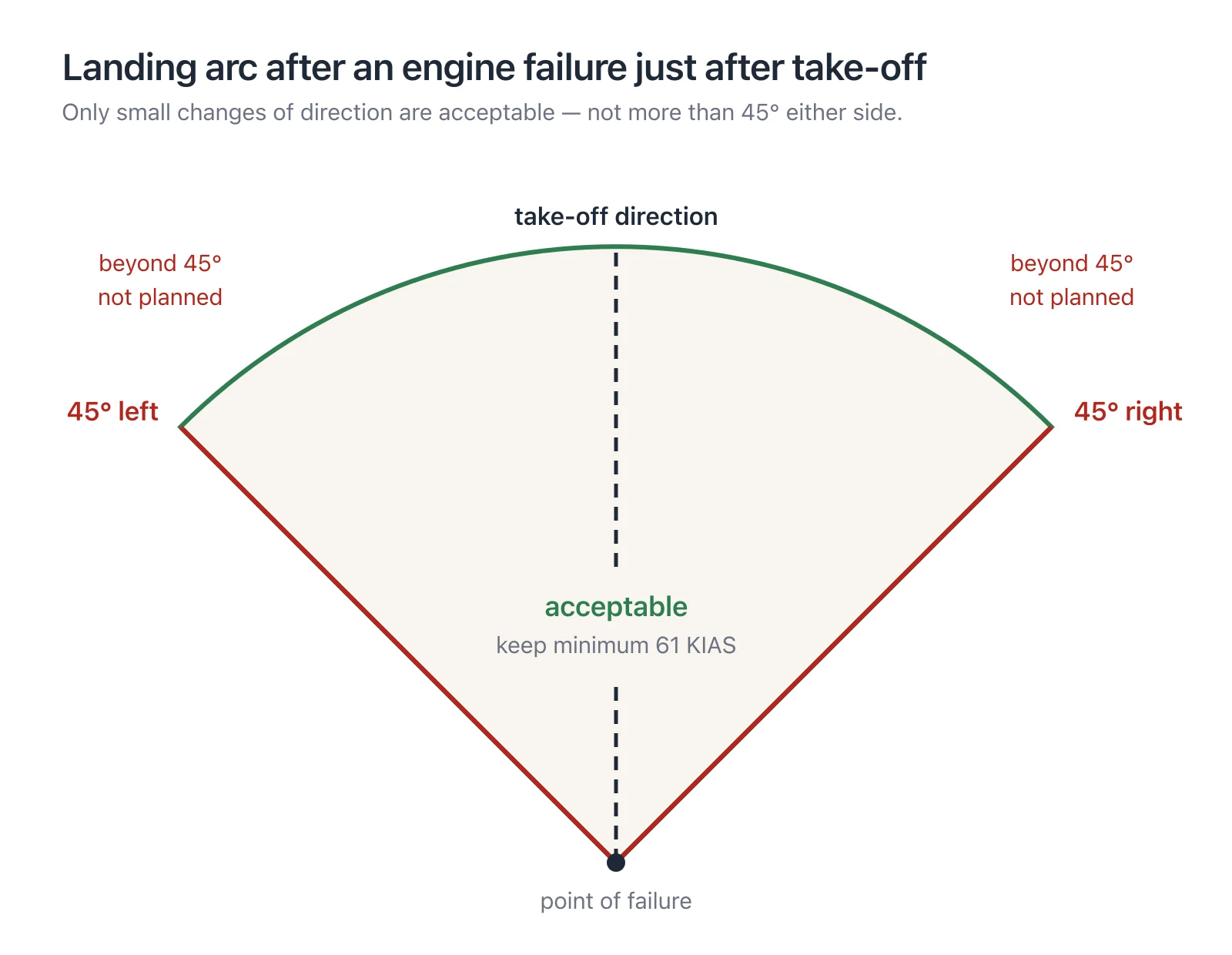
Figure: Permitted landing arc after take-off failure (redrawn).
WARNING — Bank angle and longitudinal load factor both raise the stall speed. The acoustic stall warning will in any case give a correct, anticipated cue of an incipient stall.
WARNING — Always precede a single-engine take-off with a thorough take-off emergency self-briefing. Attempt an engine restart right after take-off only where the environmental situation demands it, and never at the cost of attentively flying the immediate emergency landing, which takes priority.
In-flight engine restart
Carburettor heat — ON if required
Electrical fuel pump — ON
Fuel quantity indicator — CHECK
Fuel Selector — select the opposite tank, if not empty
Ignition key — BOTH
Ignition key — START
Throttle lever — SET as required
If the restart is unsuccessful
Engine — SECURE
Land as soon as possible, applying the forced landing procedure
WARNING — Following a mechanical engine seizure, a fire, or major propeller damage, attempting a restart is not recommended.
Check yourself
What are the first three actions if the engine fails during the take-off run?
What minimum speed do you keep after an engine failure immediately following take-off?
How far either side of straight ahead may you turn to reach a landing area?
What two things raise the stall speed, according to the warning in this lesson?
In the in-flight restart, what position is the ignition key set to before START?
After what three kinds of damage is a restart attempt not recommended?
Study aid — always fly your aircraft's current AFM/POH.
Source: AFM Doc. No. 2008/100, 2nd Edition Rev. 12 (20 October 2023), p. MT3-9, 3-14, Ed. 2 Rev. 0
You're reading a free preview. Create an account to unlock every lesson, drill, and diagram.
- 04 · LOCKEDAbnormal Engine Indications
- 05 · LOCKEDFire
- 06 · LOCKEDForced Landings
- 07 · LOCKEDLanding with a Flat Tire
- 08 · LOCKEDSpin Recovery
- 09 · LOCKEDIcing and Carburettor Ice
- 10 · LOCKEDTrim, Flap and Static Port Failures