PA44 · Limitations · 02 of 12
Airspeed Indicator Markings
- 01 · LOCKEDAirspeed Limitations
02 · READING NOW
Airspeed Indicator Markings
The airspeed indicator carries the speed limits as colours. Besides its three bands and the never-exceed line it has a blue line and a second red line, both for flight with one engine inoperative.
At a glance
- Red line (never exceed)202 KTS
- Yellow band (smooth air only)169 – 202 KTS
- Green band (normal operating)57 – 169 KTS
- White band (flap down)55 – 111 KTS
- Blue line (one engine inop best rate of climb)88 KTS
- Red line (one engine inop VMCA)56 KTS
The bands
White band — the flap-down range, 55 KTS to 111 KTS.
Green band — the normal operating range, 57 KTS to 169 KTS.
Yellow band — the caution range, 169 KTS to 202 KTS, for smooth air only.
The lines
Red line at 202 KTS — never exceed.
Blue line at 88 KTS — one engine inoperative best rate of climb speed.
Red line at 56 KTS — one engine inoperative air minimum control speed.
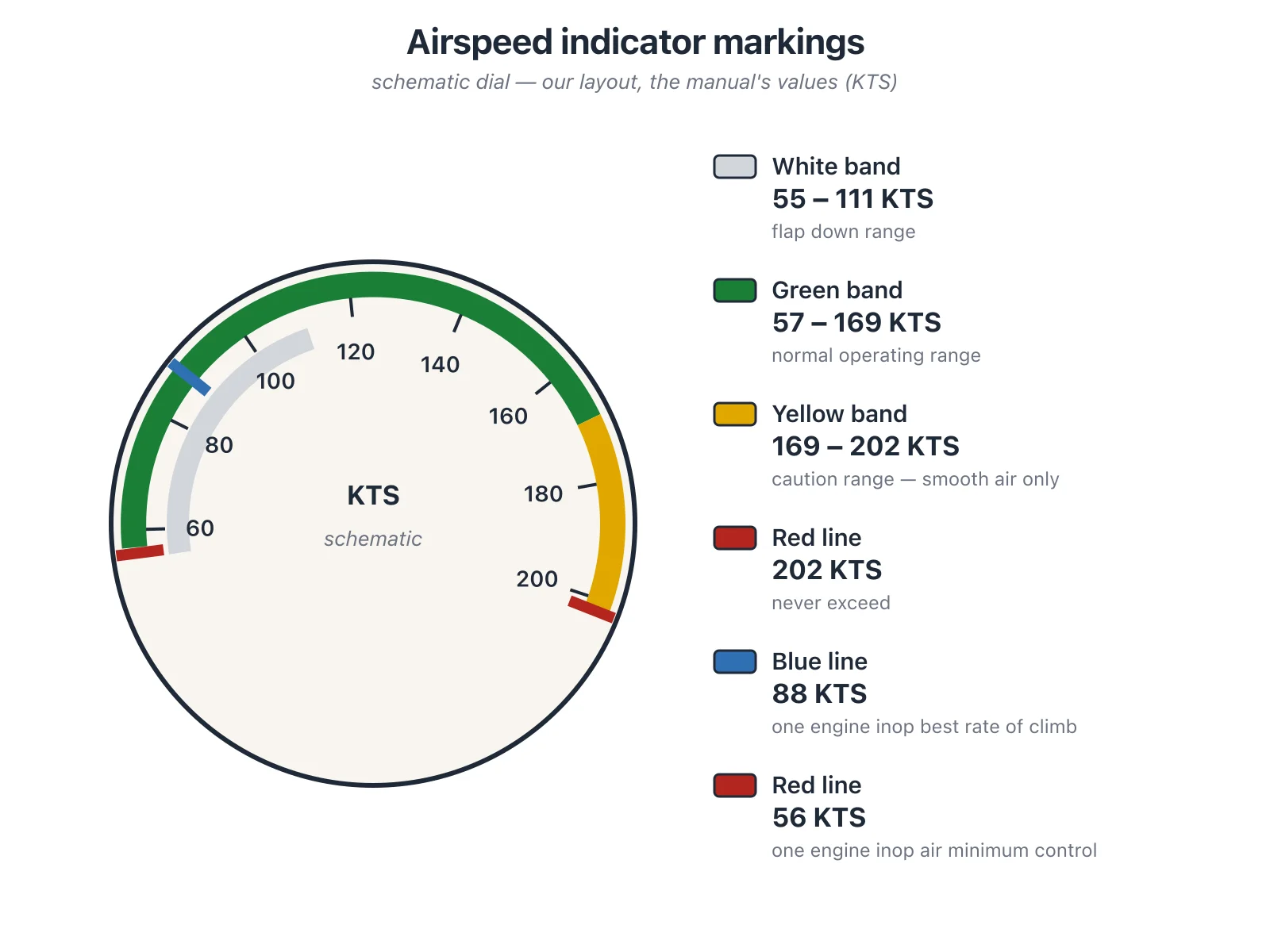
Figure: Airspeed indicator markings (redrawn).
Each colour boundary is one of the limits in the airspeed table: the top of the white band is VFE (111), the top of the green is VNO (169), and the upper red line is VNE (202).
Check yourself
What range does the white band cover, and what does it mean?
Where does the green band end and the yellow band begin?
What does the blue line mark, and at what speed?
What does the lower red line mark, and at what speed?
Study aid — always fly your aircraft's current AFM/POH.
Source: Piper PA-44-180 Seminole Pilot's Operating Handbook and FAA Approved Airplane Flight Manual, Report VB-2636, p. 2-2, Rev. 7 (26 February 2021)
You're reading a free preview. Create an account to unlock every lesson, drill, and diagram.
- 03 · LOCKEDPowerplant Limitations
- 04 · LOCKEDEngine Instrument Markings and Electrical Limits
- 05 · LOCKEDWeight and Center of Gravity Limits
- 06 · LOCKEDManeuvers, Load Factors and Kinds of Operation
- 07 · LOCKEDGPS Navigation Limitations
- 08 · LOCKEDApproach and Vertical Guidance Limitations
- 09 · LOCKEDTerrain, Traffic, Weather and Display Limitations
- 10 · LOCKEDMinimum Equipment and Standby Instruments
- 11 · LOCKEDAutopilot Limitations
- 12 · LOCKEDPlacards