PA28-161 · Limitations · 01 of 05
Airspeed Limitations and Indicator Markings
01 · Reading now
Airspeed Limitations and Indicator Markings
The airspeed limits are the first numbers a student is expected to know cold. Each one is given in knots indicated and calibrated, and each has a place on the airspeed indicator.
At a glance
- VNE, never exceed160 KIAS
- VNO, maximum structural cruising126 KIAS
- VFE, maximum flaps extended103 KIAS
- VA at 2440 lb111 KIAS
- VA at 1531 lb88 KIAS
- White arc (flap down)44 to 103 KIAS
- Green arc (normal operating)50 to 126 KIAS
- Yellow arc (caution, smooth air only)126 to 160 KIAS
- Red radial line (never exceed)160 KIAS
The limits
Never exceed speed, VNE — 160 KIAS (153 KCAS). Not to be exceeded in any operation.
Maximum structural cruising speed, VNO — 126 KIAS (122 KCAS). Exceed it only in smooth air, and even then with caution.
Maximum flaps extended speed, VFE — 103 KIAS (100 KCAS). Not to be exceeded with the flaps extended.
Design maneuvering speed, VA — 111 KIAS (108 KCAS) at 2440 lb gross weight and 88 KIAS (89 KCAS) at 1531 lb gross weight. No full or abrupt control movements above it.
CAUTION — Maneuvering speed falls as the airplane gets lighter, because aerodynamic forces become more pronounced. Between the two listed weights, linear interpolation may be used. Do not exceed VA in rough air.
Airspeed indicator markings
Each limit is painted on the dial. The white arc runs from 44 to 103 KIAS for flap-down operation; the green arc, the normal operating range, from 50 to 126 KIAS; the yellow caution arc, for smooth air only, from 126 to 160 KIAS; and the red radial line at 160 KIAS marks the never exceed speed.
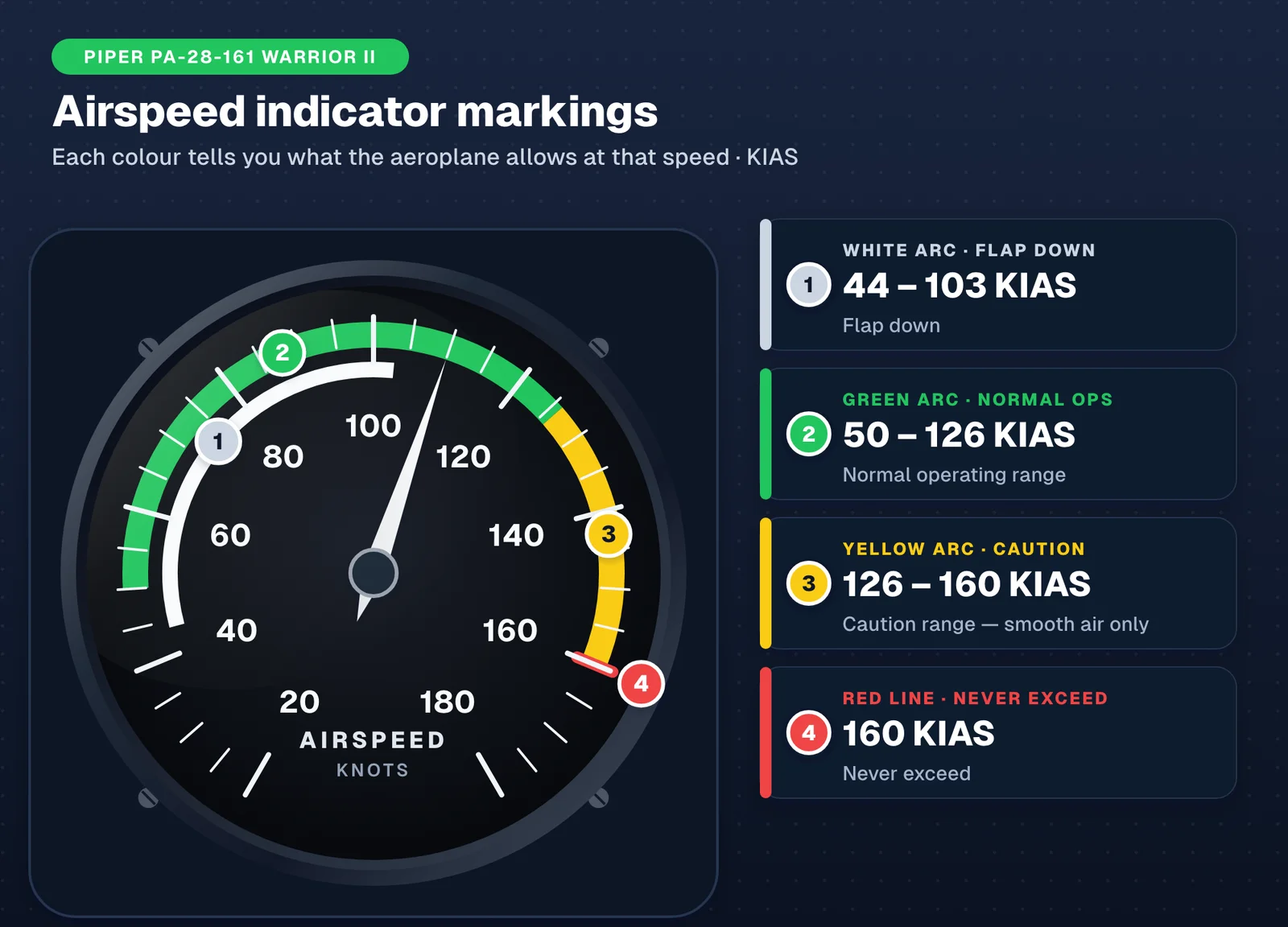
Figure: Airspeed indicator markings (redrawn).
The arc ends line up with the limits: the top of the white arc is VFE, the top of the green arc is VNO, and the red line is VNE.
Check yourself
What are VNE, VNO and VFE in KIAS?
What are the two maneuvering speeds, and at what weights?
Why does maneuvering speed fall at lighter weights, and how is it found between the listed weights?
Which arc marks the caution range, and when may you fly in it?
Which limit does the top of each arc correspond to?
Study aid — always fly your aircraft's current AFM/POH.
Source: Piper PA-28-161 Warrior II Pilot's Operating Handbook and FAA Approved Airplane Flight Manual, Report VB-1180, p. 2-1..2-2, Rev. 9 (17 July 2015)
You're reading a free preview. Create an account to unlock every lesson, drill, and diagram.
- 02 · LOCKEDPowerplant Limitations and Instrument Markings
- 04 · LOCKEDManeuvers, Load Factors and Kinds of Operation
- 05 · LOCKEDPlacards