C172M-DIESEL · Performance · 05 of 06
Stall Speeds
- 01 · LOCKEDChart Conditions and Correction Factors
- 03 · LOCKEDClimb Performance
- 04 · LOCKEDCruise, Range and Endurance
05 · Reading now
Stall Speeds
Stall speed rises with bank angle, and the published table shows exactly how much. The pattern is the same at every flap setting: nothing much happens up to 20° of bank, and then it runs away from you.
At a glance
- Conditions2300 lbs gross weight, power off, aft CG, speeds in MPH CAS
- Flaps up57 / 59 / 65 / 81 at 0 / 20 / 40 / 60° angle of bank
- Flaps 10°52 / 54 / 59 / 74 at 0 / 20 / 40 / 60° angle of bank
- Flaps 40°49 / 51 / 56 / 69 at 0 / 20 / 40 / 60° angle of bank
The three flap settings
All figures are at 2300 lbs gross weight, power off, aft CG, in MPH CAS:
Flaps up: 57 at 0°, 59 at 20°, 65 at 40°, 81 at 60° angle of bank
Flaps 10°: 52 at 0°, 54 at 20°, 59 at 40°, 74 at 60° angle of bank
Flaps 40°: 49 at 0°, 51 at 20°, 56 at 40°, 69 at 60° angle of bank
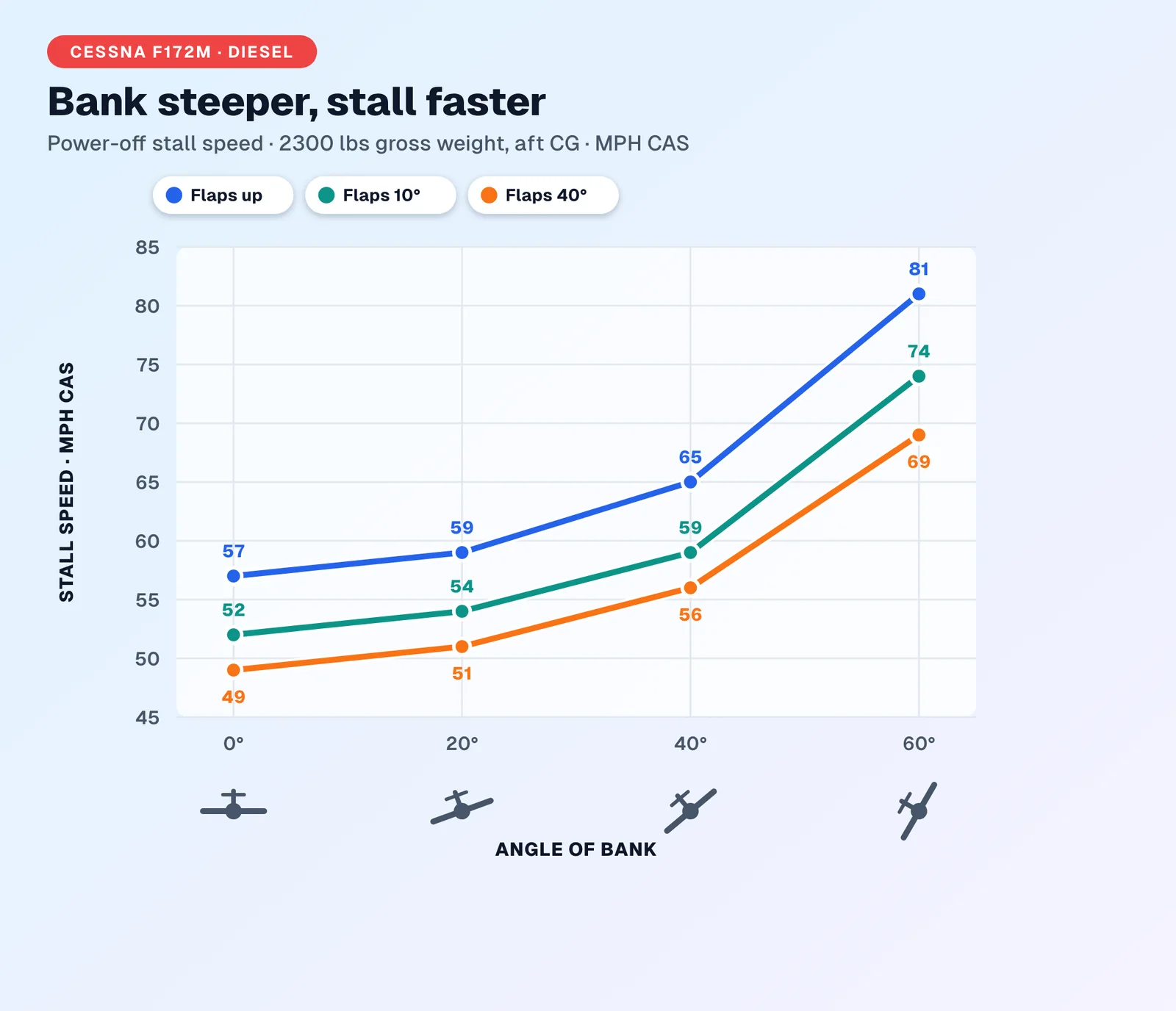
Figure: Power-off stall speed against angle of bank, MPH CAS (redrawn).
The shape of the curve
Read across any row and the same story appears. From wings level to 20° of bank the stall speed rises by only two MPH; from 40° to 60° it rises by thirteen to sixteen. The last twenty degrees of bank cost you more than the first forty.
Check yourself
Under what four conditions are these stall speeds published?
What is the stall speed flaps up at 60° of bank, and flaps 40° at 60° of bank?
How much does the stall speed rise between 0° and 20° of bank?
Which flap setting gives the lowest stall speed at every bank angle?
Study aid — always fly your aircraft's current AFM/POH.
Source: Student Pilot's Operating Handbook, (Reims) Cessna F172M / TAE 125-02-114, p. 5-8
You're reading a free preview. Create an account to unlock every lesson, drill, and diagram.
- 06 · LOCKEDLanding and Glide Performance